Table Of Content
Digital designs should be straightforward and intuitive with clear navigation, recognizable icons, and logical flows to help users understand how to interact with the digital space, regardless of their familiarity with technology. Creating user experiences that are inclusive should be an important objective of every project, and one way to ensure this happens is by using the seven principles of universal design to guide the design process. Everyone navigates the built environment differently, with abilities changing across a person's lifespan. Universal Design is a solid approach to design because the seven principles help us consider the needs of all users in general. Universal Design benefits everyone, not just the aging population or people with disability. The Principles of Universal Design is a great resource for us to use when we want to design accessible websites, ones which serve and cater to as many users as possible.
Perceptible Information Guidelines
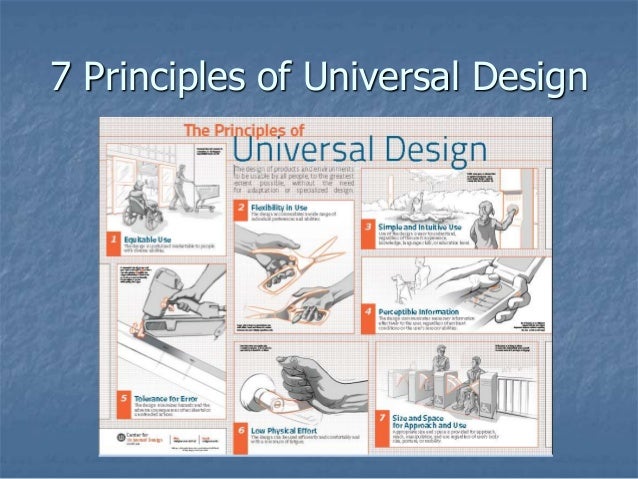
See the Design for All chapter by Constantine Stephanidis in The Encyclopedia of Human-Computer Interaction. Equitable use is the first universal design principle, and it states that a design should be marketable and useful to the public with their diverse abilities. In summary, this principle makes the same use means available to all its users, either identically or equivalently. The rule also tries to avoid the segregation of any user with provisions of the necessities such as privacy, security, and safety. Use of the design is easy to understand, regardless of the user's experience, knowledge, language skills, or current concentration level.

Guidelines for Perceptible Information
Flexibility in use is the second universal design principle, and it states that a design should accommodate an extensive range of each person’s specific abilities and preferences. This principle seeks to welcome varied methods of using facilities and such to help in the adaptability and accuracy of users. As the digital world is such a prominent feature in all of our daily lives, the concept of universal design plays a central role. For example, classic examples of Universal Design and digital accessibility include the provision of alternative text descriptions for images on websites.
What is the definition of UD?
In our interconnected digital world, it’s wise to remember that the journey isn’t the same for everyone. The seemingly straightforward task of navigating a website, reading an article, or watching a video can be a challenging process for many people.This is where the principles of Universal Design make their most significant impact. Furthermore, incorporating closed captions and transcripts for audio and video content enhances accessibility for deaf and hard-of-hearing individuals.
How to Create Effective Journey Maps: Learnings from the IxDF Course
In addition, universal design provides a set of principles that can be used to steer a design toward specific objectives, while inclusive design is a method that calls for a diverse set of individuals to participate in the design process. As a result, universal and inclusive design go about creating designs for diverse users in different ways. Universal design, inclusive design, and design for all share common ground. In universal design, you create a single solution to accommodate a wide range of users, including many factors to satisfy the most users possible. Additionally, you incorporate insights about the users’ physical and cognitive abilities, age, gender, race, and ethnicity into the design of one experience. This will be a product or service that they all can access, use and enjoy.
Guidelines for Low Physical Effort
A group at The Center for Universal Design at North Carolina State University developed the concept further in 1997. Permits storing data to personalize content and ads across Google services based on user behavior, enhancing overall user experience. How easy is your design for someone to pick up and start using immediately without instruction? The easier it is for someone to use irrespective of their previous skills, experiences or learning and irrespective of their ability to concentrate for long periods of time; the easier it will be for a wide-range of user to use it. The National Disability Authority (NDA) is the independent statutory body that provides information and advice to Government on policy and practice relevant to the lives of persons with disabilities.
7 simple landscape designs that make cities better for everyone - Fast Company
7 simple landscape designs that make cities better for everyone.
Posted: Tue, 20 Aug 2019 07:00:00 GMT [source]
It’s a win-win situation for both the users and the companies or organizations we design for.© TED Conferences, LLC., Fair Use. It reduces visual clutter and removes irrelevant information on the screen. It prioritizes information to display on the screen based on user needs and interactions.
Built Environment
Allows for content and ad personalization across Google services based on user behavior. Please note that the Principles of Universal Design address only universally usable design, while the practice of design involves more than consideration for usability. Designers must also incorporate other considerations such as economic, engineering, cultural, gender, and environmental concerns in their design processes. These Principles offer designers guidance to better integrate features that meet the needs of as many users as possible. Architecture is the science and art of designing and constructing buildings for people to use and dwell in; as such good architecture should be defined by inclusivity. Inclusivity involves providing equal access to resources and opportunities for people who might have been marginalised originally due to their unique and diverse abilities.
Save and print the Guidelines Graphic Organizer including translated and past versions. Because the UDL Guidelines are meant to be informed by feedback from the field as well as new research, they have been updated several times in the past. CareerFoundry is an online school for people looking to switch to a rewarding career in tech. Select a program, get paired with an expert mentor and tutor, and become a job-ready designer, developer, or analyst from scratch, or your money back. For example, relevant navigation should be anchored at the top of a webpage, so the user doesn’t have to scroll to the top whenever they wish to go to a different part of a website. Data Validation – Check to make sure whether the data the user entered is in the correct context.
The facility is made up of exhibition space, a childcare centre, a café, offices, a fitness centre, community meeting rooms and job training facilities in an area of 7900m2. You’ll also promote a more equitable world for people, which is what the UserWay mission is all about. Benefit from a friendly consultation or start your free trial with us today. By understanding these universal principles of design, we can create physical and digital spaces and products that are more accessible and user-friendly for all users. This principle considers aspects of design that reduces the physical strain on users, particularly those with limited mobility or physical disabilities. In digital spaces, this could mean designing interfaces that can be navigated with minimal physical effort, such as keyboard-friendly designs and touch-screen friendly controls.
It can suit users who prefer it because it may be easier on the eye for them, or “just because” (it’s more to their taste). The following list provides an example of a process for applying universal design in higher education (UDHE). A person who is blind and using a screen reader can access the content in images because text descriptions are provided. Multiple forms of accessibly designed media are used to communicate services provided. The following table provides examples of practices that build upon each of the items in the four sets of principles that underpin the UD Framework. The following examples for the Universal Design of Instruction that employ all three sets of UD principles were developed by the AccessCollege project of the DO-IT Center with input from a nationwide collaborative team.




No comments:
Post a Comment